Computing for mechanics and mechanics for computing
A Corigliano, L Rosafalco, M Torzoni
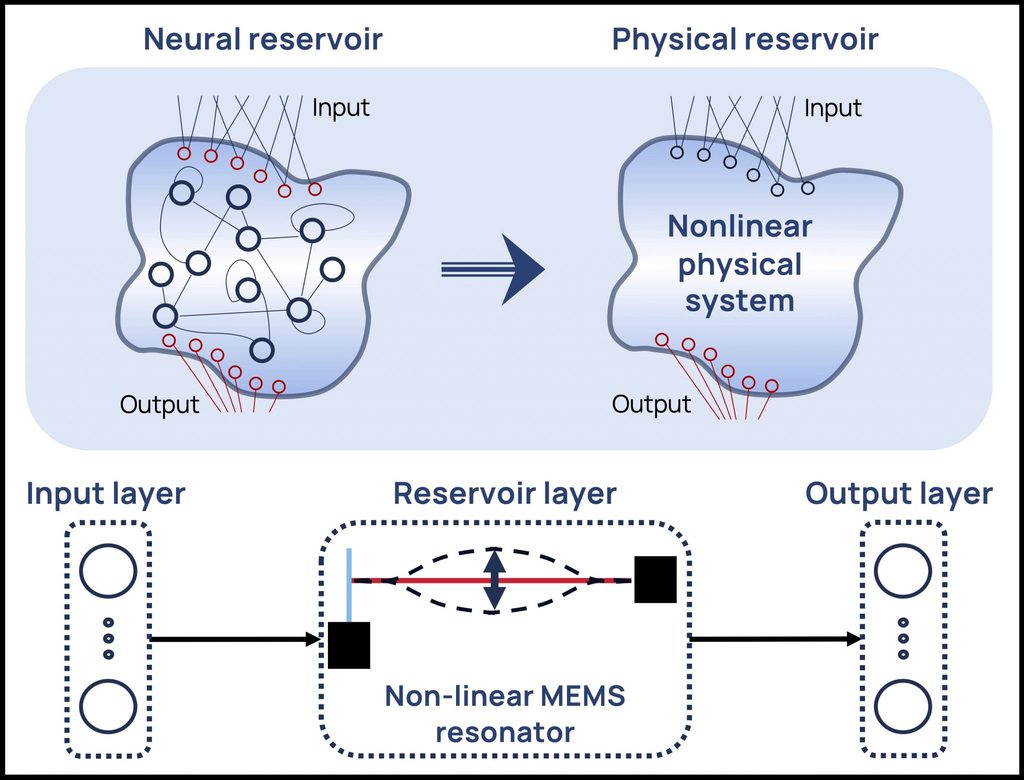
As Artificial Intelligence, scientific computing, and sensing technologies continue to evolve, mechanics is undergoing a profound transformation. In this perspective, we discuss two complementary research directions: computing for mechanics, where AI and computational methods enhance simulation, optimization, monitoring, and control; and mechanics for computing, where materials and structures themselves perform computational tasks. We argue that the convergence of these paradigms could lead to sentient materials and structures by integrating sensing, learning, and adaptation into physical systems.
Truss structure optimization via hierarchical tree search
A Sedighzadeh, M Torzoni, A Corigliano
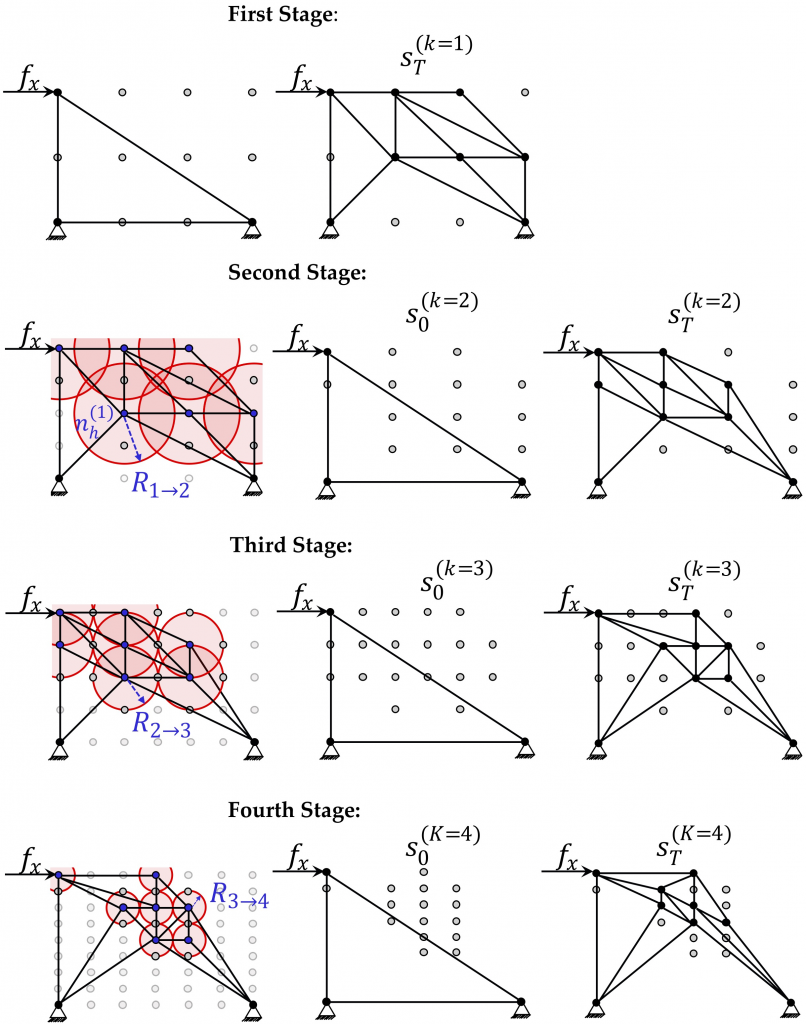
Previous work has shown that truss optimization can be formulated as a grammar-constrained Markov decision process and solved by using Monte Carlo tree Search (MCTS) to learn an optimal design policy. While this strategy outperforms both metaheuristic methods, such as genetic algorithms, and alternative reinforcement learning approaches, including Q-learning and deep Q-learning, its computational scalability is limited in dense grid design domains. To address these limitations, this study proposes a hierarchical MCTS framework in which staged grid refinements focus computational resources on promising regions of the domain. Compared to single-stage evaluations, H-MCTS consistently improves design quality while reducing computational cost. Real-time adaptivity is also achieved through an offline–online strategy that precomputes optimal solutions and interpolates them during deployment.
Active digital twins via active inference
M Torzoni, D Maisto, A Manzoni, F Donnarumma,
G Pezzulo, and A Corigliano
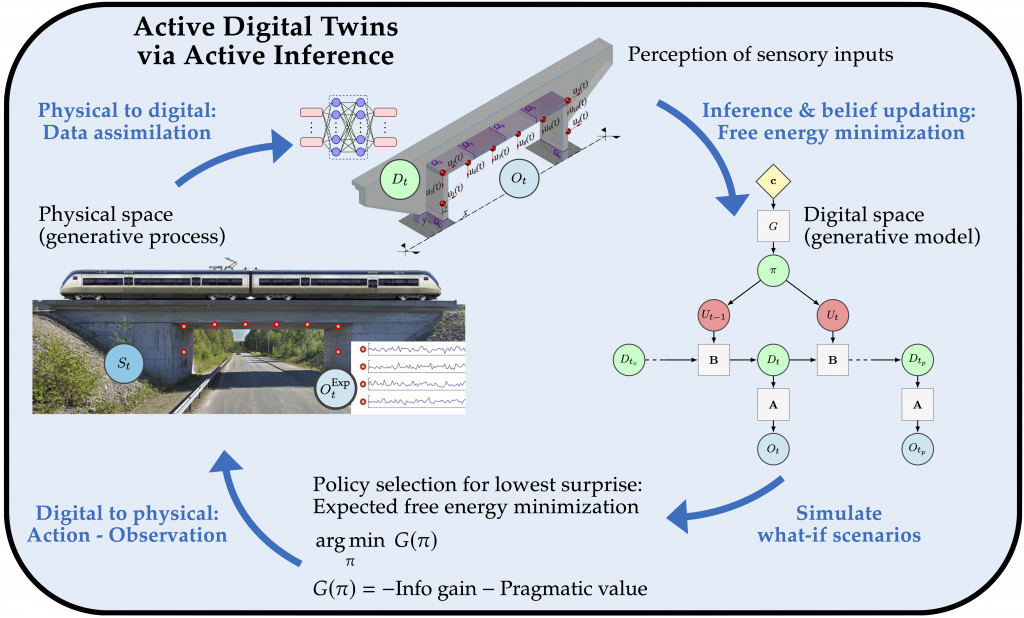
This research introduces “active digital twins”, built upon the neuroscience-inspired active inference paradigm. The proposed closed-loop perception–action framework integrates reasoning, decision-making, and learning, enabling digital twins to autonomously balance goal-directed and information-seeking behaviors. Demonstrations in structural health monitoring and predictive maintenance scenarios highlight how uncertainty-resolving actions help maintain synchronization between physical assets and their digital counterparts.
Mastering Truss Structure Optimization With Tree Search
G Garayalde, L Rosafalco, M Torzoni, A Corigliano
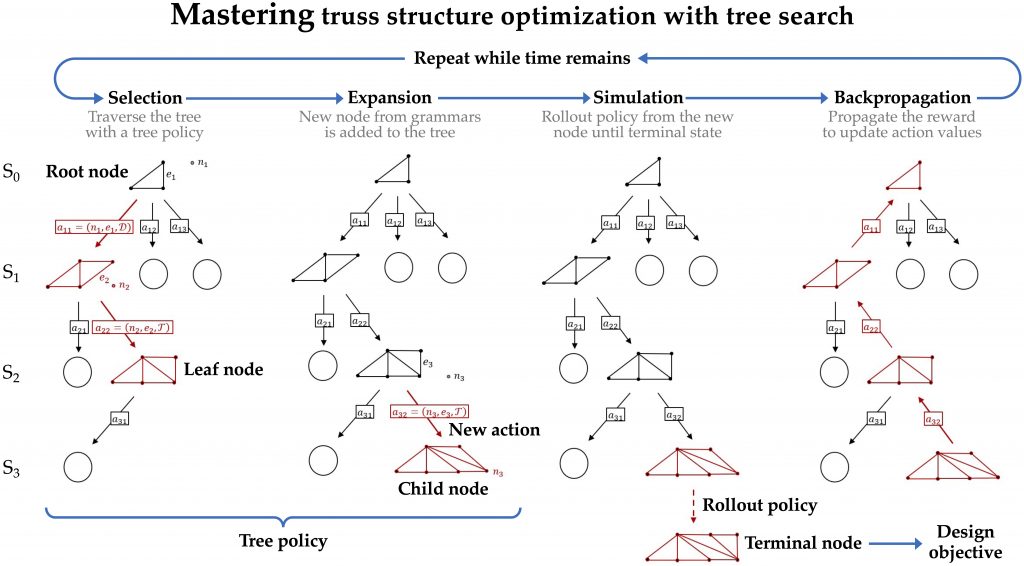
Truss structures must satisfy mechanical requirements and practical constraints related to fabrication, transportation, and assembly. These factors make truss design a highly constrained problem, where traditional optimization methods often struggle due to high computational demands and slow convergence. This paper introduces an innovative approach that frames truss design as a sequential decision-making problem, addressed through reinforcement learning combined with generative grammar rules. By emulating a continuous human-computer interaction and effectively balancing the exploration and exploitation of design alternatives, this method outperforms traditional techniques in computational efficiency for structural design tasks.